
Chesterton on Mary : some reflections on his devotion to the Mother of God
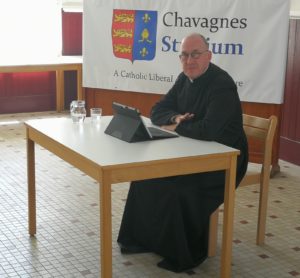 by Father Mark Lawler
(Paper delivered at the 2016 Chavagnes Summer Conference)
Gilbert Keith Chesterton was born on May 29th, 1874 into a family which though Unitarian, was not particularly religious. As a young man he moved from agnosticism to Anglicanism, and under the influence of his future wife, Frances, became an Anglo-Catholic. He was finally received into the Catholic Church in 1922 at the age of 48. Throughout his spiritual journey the Blessed Virgin Mary was always before his eyes. He wrote that “The very idea of Our Lady drew me . … out of ordinary Protestantism, by being herself, that is, by being beautiful.”[1] He died, fortified by the rites of Holy Church, on June 14th 1936.
Chesterton certainly agreed with the maxim: “De Maria numquam satis”, ‘of Mary one can never say enough.’ He wrote reams of poetry about her from his youth to his dying day. As an agnostic sixteen-year-old he wrote a long poem entitled Ave Maria which included the lines:
We love, who have done with the churches, we worship, who may not believe.
yet ended:
O Mary, the blessed among women, sweet Mother of Mysteries, hail![2]
He was Marian even before he was Christian. It would perhaps be true to say that his love for Our Lady led Chesterton to Christian faith. It is no wonder that at his deathbed Fr Vincent McNabb kissed Chesterton’s pen and sang the Salve Regina.
Chesterton always had an affinity with Our Blessed Lady. Whether by “accident, or a highly unmerited favour of heaven” he always had a “curious longing for the remains of this particular tradition, even in a world where it was regarded as a legend”. He “was not only haunted by the idea while still stuck in the ordinary stage of schoolboy scepticism”. He recalled writing in his youth
screeds of an exceedingly bad imitation of Swinburne … addressed to what I should have called a picture of the Madonna. And I can distinctly remember reciting the lines of the “Hymn To Proserpine[3],” out of pleasure in their roll and resonance; but deliberately directing them away from Swinburne’s intention, and supposing them addressed to the new Christian Queen of life, rather than to the fallen Pagan queen of death.”
He had “obscurely, from that time onwards, the very vague but slowly clarifying idea of defending all that Constantine had set up, just as Swinburne’s Pagan had defended all he had thrown down”[4]. Thus, Our Lady was the inspiration for the man Walter De La Mere described as a “Knight of the Holy Ghost” and his life-long defence of the Faith.
Chesterton’s Mariology was best summed up in Mary and the Convert, written in 1935:
(M)en need an image, single, coloured and clear in outline, an image to be called up instantly in the imagination, when what is Catholic is to be distinguished from what claims to be Christian or even what in one sense is Christian. Now I can scarcely remember a time when the image of Our Lady did not stand up in my mind quite definitely, at the mention or the thought of all these things. I was quite distant from these things, and then doubtful about these things; and then disputing with the world for them, and with myself against them; for that is the condition before conversion. But whether the figure was distant, or was dark and mysterious, or was a scandal to my contemporaries, or was a challenge to myself – I never doubted that this figure was the figure of the Faith; that she embodied, as a complete human being still only human, all that this Thing had to say to humanity. The instant I remembered the Catholic Church, I remembered her; when I tried to forget the Catholic Church, I tried to forget her; when I finally saw what was nobler than my fate, the freest and the hardest of all my acts of freedom, it was in front of a gilded and very gaudy little image of her in the port of Brindisi, that I promised the thing that I would do, if I returned to my own land.[5]
In this passage Chesterton makes clear the part Our Blessed Lady played in his conversion. She was the person who most influenced his decision to become a Catholic. In 1907, 17 years before Chesterton’s reception, his friend Hilaire Belloc wrote to Chesterton reminding him that they both agreed in “looking up to our Dear Lady, the blessed Mother of God. I recommend to you this, that you suggest to her a comprehension for yourself, of what indeed is the permanent home of the soul. If it is here you will see it, if it is there you will see it. She never fails us. She has never failed me in any demand. … There is no connection the reason can seize – but so it is. If you say ‘I want this’ as in your case to know one way or the other – She will give it you: as She will give health or necessary money or success in pure love. She is our Blessed Mother.” [6]
A year before his death Chesterton wrote that “the cult of Mary is a personal cult” because we worship “a personal God. God is God, Maker of all things visible and invisible”.
He wrote that “the Mother of God is in a rather special sense connected with things visible; since she is of this earth, and through her bodily being God was revealed to the senses” She reminds us “especially of God Incarnate” and thus gathers up and embodies “all those elements of the heart and the higher instincts, which are the legitimate short cuts to the love of God.”[7]
The cult of Mary does not, he insists, lead us away from the Invisible God, as some Protestants suggest, but rather brings us back to her Son.
Throughout his life Chesterton was accused of Mariolatry, of giving too high a place to Mary. He felt that since God had already given her the highest place, who was he to disagree with the Almighty. “Nothing amuses Catholics more” he wrote, “than the suggestion, in so much of the old Protestant propaganda, that they are to be freed from the superstition called Mariolatry, like people freed from the burden of daylight.”[8]
Although brought up in a Protestant household he knew nothing of what he described as:
That strange mania against Mariolatry; that mad vigilance that watches for the first faint signs of the cult of Mary as for the spots of a plague; that apparently presumes her to be perpetually and secretly encroaching upon the prerogatives of Christ; that logically infers from a mere glimpse of the blue robe the presence of the Scarlet Woman.[9]
He “could never at any stage” understand why “respect paid to the Blessed Virgin” was considered controversial. He recalls a childhood incident in his local Anglican Church over whether a statue of “the Virgin and Child” was too Catholic.
After much controversy, they compromised by taking away the Child. One would think that this was even more corrupted with Mariolatry, unless the mother was counted less dangerous when deprived of a sort of weapon. But the practical difficulty is also a parable. You cannot chip away the statue of a mother from all round that of a new-born child. You cannot suspend the new-born child in mid-air; indeed, you cannot really have a statue of a new-born child at all. Similarly, you cannot suspend the idea of a new-born child in the void or think of him without thinking of his mother. You cannot visit the child without visiting the mother; you cannot in common human life approach the child except through the mother. If we are to think of Christ in this aspect at all, the other idea follows as it is followed in history. … we must admit, if only as we admit it in an old picture, that those holy heads are too near together for the haloes not to mingle and cross.”[10]
He described the honour given to Mary as the Mother of God the “most popular, the most poetical and the most practically inspiring of all the distinctively Catholic traditions. … a very perfect example of the truth . . . that even what we may call the Protestant truths were only saved by the Catholic authority. Among these is the very necessary truth of the subordination of Mary to Christ, as being after all the subordination of the creature to the Creator.” It is the authority of the Church which prevents error, not private judgment.
In fact, he adds “If Catholics had been left to their private judgment, … they would long ago have exalted our Lady to a height of … a goddess more universal than Isis”. It is, he says, only the authority of the Church that has prevented Catholics from going too far. It is the Church that defies Mariolatry, he says, by “the strict definition that distinguished between a perfect woman and a divine Man”.[11] He laments the so-called Reformers’ “insane war against everything in the old faith that is most normal and sympathetic to human nature; such as prayers for the dead or the gracious image of a Mother of Men.”[12] In his poem, Lepanto written in 1911, 11 years before his conversion, he points out the absurdity of this Protestant position:
“And Christian hateth Mary that God kissed in Galilee”.[13]
In 1924 Arnold Lunn, then an avowed atheist, wrote: ”You hear a great deal about His Mother, for Our Lady has become the patron of a party, whereas Christ was never a party leader.”[14]
— Chesterton replied in verse:
Mother of Man; the Mother of the Maker;
She named no hypocrites a viper race,
She nailed no tyrant for a vulpine cur.
She flogged no hucksters from the holy place;
Why was your new wise world in dread of her?
The poem ends:
But when that tangled war our fathers waged Stirred against her
—then could we hear right well,
Through roar of men not wrongfully enraged.
The little hiss that only comes from hell.” [15]
Chesterton believed any attack on the Mother of God to be literally diabolical because there was an eternal battle between the Woman and the Serpent. “I will put enmities between thee and the woman, and thy seed and her seed: she shall crush thy head, and thou shalt lie in wait for her heel.”[16] He sums up more than four centuries of attacks on our Blessed Mother as a “little hiss that only comes from hell.”
And we can still hear that “little hiss” from those who claim that holding Our Blessed Mother up as a model is mere sentimentality and of no practical use. For instance, we still hear today: It is not practical to ask young people to be chaste, so we should instead instruct them in so-called “safe sex”. Contemplating Our Blessed Mother has, Chesterton asserts, a strong moral power:
A man who is continent, for example, from a contemplation of the Virgin Mary, is in a vastly better condition of moral hygiene than a man who is continent from reading Ibsen’s Ghosts, [a play which includes such things as incest, euthanasia, sexually transmitted diseases,] for the very obvious reason that the first man’s attention is turned to beauty, strength, and the obvious good, and the second man’s attention to deformity, impotence, and diseased perversity. Here, as is generally the case, sentiment is found to be vastly more practical than ‘practicality.’[17]
Chesterton’s assertion that the Virgin Mary “embodied as a complete human being . . . all that (the Church) has to say to humanity” concurs with the ecclesial Mariology we find in The Dogmatic Constitution on the Church of Vatican II (“Lumen Gentium”) which stated that Mary “in a certain way unites and mirrors within herself the central truths of the faith.”[18]
In his Autobiography he relates the controversy over the erection of a Memorial to those who fell in the Great War in his home town of Beaconsfield. Despite considerable anti-Catholic resistance a Crucifix was erected as a compromise. Chesterton was not pleased.
“I do not want the crucifix to be a compromise, or a concession to the weaker brethren, or a makeweight or a by-product. I want it to be a blazon and a boast. I want there to be no more doubt about our all glorying in it than there would have been in any body of old Crusaders pitting the Cross against the Crescent. And if anyone wants to know my feelings about a point on which I touch rarely and with reluctance: the relation of the Church I left to the Church I joined, there is the answer as compact and concrete as a stone image. I do not want to be in a religion in which I am allowed to have a crucifix. I feel the same about the much more controversial question of the honour paid to the Blessed Virgin. If people do not like that cult, they are quite right not to be Catholics. But in people who are Catholics, or call themselves Catholics, I want the idea not only liked but loved and loved ardently, and above all proudly proclaimed. I want it to be what the Protestants are perfectly right in calling it; the badge and sign of a Papist. I want to be allowed to be enthusiastic about the existence of the enthusiasm; not to have my chief enthusiasm coldly tolerated as an eccentricity of myself.[19]
The idea that Our Blessed Lady as the perfect model of the Church should be “proudly proclaimed” is not unique to Chesterton, of course. Cardinal Ratzinger agreed:
“In Mary, as figure and archetype, the Church again finds her own visage as Mother and cannot degenerate into the complexity of a party, an organization or a pressure group in the service of human interests, even the noblest. If Mary no longer finds a place in many theologies and ecclesiologies, the reason is obvious: they have reduced faith to an abstraction. And an abstraction does not need a Mother.”[20]
Chesterton asserts that we need a Mother and asks why the world is so afraid of her?
Concerning the Faith, and Our Blessed Mother in particular, he could never claim impartiality. “It is impossible for any man to state what he believes as if he did not believe it. …. And on this last matter of the doctrine touching the Virgin I will conclude without further speech. It is only reasonable that a creed presented by one who holds it should be stated with conviction; but anything I wrote on this last topic might be defaced with enthusiasm.”[21]
For Chesterton the image of Our Lady, “the Mother of Men”, meant home and hearth. Explaining why, despite poor health, he made his 1930 visit to Indiana, and Notre Dame University, he said: “the reason is in the name of your University. That name was quite sufficient as far as I was concerned. It would not have mattered if It had been in the mountains of the moon. Wherever she has erected her pillars, all men are at home, and I knew that I should not find strangers.”[22]
She whom God Himself exalted, the “woman clothed with the sun, and the moon under her feet, and on her head a crown of twelve stars”[23] will be there for our comfort:
A Woman clothed with the sun returning
to clothe the sun when the sun is cold.[24]
On a visit to Poland he visited a palace had been left in ruins by the Red Army after the Battle of Warsaw. He was moved by “a statue of the Blessed Virgin; with the head and the hands shot off. But the hands had been lifted; and it is a strange thing that the very mutilation seemed to give more meaning to the attitude of intercession; asking mercy for the merciless race of men.”[25]
In his two epic poems, Lepanto et The Ballad of the White Horse, Chesterton credits the Blessed Virgin with victory over the enemies of Christendom. This idea that Our Blessed Mother “embodied as a complete human being . . . all that (the Church) has to say to humanity” comes out clearly in Chesterton’s poetry. I would like to look at a few examples.
The Ballad of the White Horse,[26] published in 1911, tells the epic tale of King Alfred’s battles against the Danish invaders in the ninth century.
A defeated, bedraggled Alfred sees a vision of the “Mother of God” and asks to know the future. Will victory be his? “Shall we come home at last?” Mary replies that “if he fail or if he wins to no good man is told”. She will neither tell Alfred the future, nor assure him of anything.
Those who are Signed of the cross of Christ
Go gaily in the dark
Alfred must face the coming battle with Christian courage. Our Lady tells him:
“But you and all the kind of Christ
Are ignorant and brave,
You have wars you hardly win
And souls you hardly save
Alfred is given no assurance of victory against the Danes. Rather, Our Lady tells him, there is
naught for your comfort
Yea, naught for your desire
Save that the sky grows darker yet
And the sea rises higher
“Night shall be thrice night over you,
And heaven an iron cope.
Do you have joy without a cause,
Yea, faith without a hope?”
He takes this message of “joy without a cause” and “faith without a hope” to his supporters and convinces them to fight, not by promising victory, but by “the word of Mary, The word of the world’s desire”.
“Out of the mouth of the Mother of God
Like a little word come I;
For I go gathering Christian men
From sunken paving and ford and fen,
To die in a battle, God knows when,
By God, but I know why.
“I am that oft-defeated King
Whose failure fills the land,
Who fled before the Danes of old,
“But out of the mouth of the Mother of God
I have seen the truth like fire,
This–that the sky grows darker yet
And the sea rises higher
When the Battle of Ethandune was all but lost, Alfred having told the remnant of his army that “death is a better ale to drink” than “to drink up infamy?”, blew his horn as:
The people of the peace of God
Went roaring down to die
But when “the hopeless horn was blown” and his soldiers went “roaring down to die” Alfred saw Our Lady again; no longer “causeless joy and hopeless faith” but Causa Nostrae Laetitiae (Cause of Our Joy).
Over the iron forest
He saw Our Lady stand,
Her eyes were sad withouten art,
And seven swords were in her heart–
But one was in her hand.
Chesterton’s verse brings to mind the Song of Solomon: “Who is she that cometh forth as the morning rising, fair as the moon, bright as the sun, terrible as an army set in array?”[27]
And as the battle rages:
The Mother of God goes over them,
Walking on wind and flame,
The Mother of God goes over them,
On dreadful cherubs borne;
The battle is won, the Danish King Guthrum is baptised. Peace reigns in Wessex. However, Chesterton warns
I have a vision, and I know
The heathen shall return.
They shall not come with warships,
They shall not waste with brands,
But books be all their eating,
And ink be on their hands.
The battle is never over, and Our Blessed Mother is always ready with sword in hand. The new barbarians are here. We need supernatural help with these wars we hardly win and souls we hardly save. Our Blessed Mother’s intervention in Alfred’s earthly combat reflects her part also in that supernatural battle against the devil and sin. Chesterton tells us that:
This world can be made beautiful again by beholding it as a battlefield. When we have defined and isolated the evil thing, the colours come back into everything else. When evil things have become evil, good things, in a blazing apocalypse, become good. There are some men who are dreary because they do not believe in God; but there are many others who are dreary because they do not believe in the devil. The grass grows green again when we believe in the devil, the roses grow red again when we believe in the devil.[28]
Just as Our Lady comes to the aid of Alfred, “that oft-defeated King whose failure fills the land”, so in Queen of the Seven Swords, written in 1926, she also comes to the aid of other great heroes of Christendom who have suffered apparent defeat in the cause of the Faith: St. James of Spain, St. Denys of France, St. Anthony of Italy and St. Patrick of Ireland, St. Andrew of Scotland, St. David of Wales & St. George of England. After apparent failure they return to the Mother of God saying, “We that have loved have failed thee. Oh, fail us not!” She replies:
“Knew ye not, ye that seek, wherein I have hidden all things?
Strewn far as the last lost battle; your swords have met in my heart.”[29]
Mary re-arms the saints with the seven swords from her wounded heart and charges them to reconquer Christendom.
The Seven Swords of her Sorrow held out their hilts like a challenge,
The blast of that stunning silence as a sevenfold trumpet blew
Majestic in more than gold, girt round with a glory of iron,
The hub of her wheel of weapons; with a truth beyond torture, true.
For Chesterton Our Blessed Mother represents the Church victorious; “our Lady of the Victories, The Mother of the Master of the Masters of the World”.[30] In his great defence of the Faith, Orthodoxy, written 14 years before his conversion he describes the Church as: “the heavenly chariot (that) flies thundering through the ages, the dull heresies sprawling and prostrate, the wild truth reeling but erect”.[31] Chesterton came to understand that the Blessed Mother was the complete Image of the Church. As he put it years later in his poem Queen of the Seven Swords:
But erect in the earth’s despair and arisen against heaven interceding,
Whose name is Cause of Our Joy, in the doorway of death she stood.[32]
It is she, “Mother of Man; the Mother of the Maker”[33], who literally brings God and man together. And it is she who brings Christ to us.
While looking for a statue of Our Lady for his local church, Chesterton saw all kinds of examples in a Catholic shop in London, but none appealed to him. Then, as he accompanied the proprietor to an upper storeroom, he noticed a statue. “[S]he was standing there, amid planks and shavings and sawdust, as she stood in the carpenter’s shop in Nazareth.”[34] “She was a peasant and she was a queen, and in that sense she was a lady; but not the sort of sham lady who pretends to be a peasant, not the sham peasant who pretends to be a lady.” Chesterton presented the statue to his parish church in Beaconsfield, where, as he puts it, “She looks across the church with an intense earnestness in which there is something of endless youth; and I have sometimes started, as if I had actually heard the words spoken across that emptiness: “I am the Mother of God and this is Himself, and He is the boy you will all be wanting at the last.”[35]
NOTES
[1] G. K. Chesterton, Where All Roads Lead, Collected Works 3, (San Francisco: Ignatius, 1990),39.
[2] G. K. Chesterton, Ave Maria, Collected Works 10 part 1, (San Francisco: Ignatius, 1994),116.
[3] “Hymn to Proserpine” by Algernon Charles Swinburne, published in Poems and Ballads in 1866, is addressed to the goddess Proserpina, the Roman equivalent of Persephone, but laments the rise of Christianity for displacing the pagan goddess and her pantheon. The lines Chesterton readdressed to Our Lady run:
“But I turn to her still; having seen she shall surely abide in the end;
Goddess and maiden and queen, be near me now and befriend.”
[4] G. K. Chesterton, The Well and the Shallows, Collected Works 3, (San Francisco: Ignatius, 1990), 462.
[5] G. K Chesterton, The Well and the Shallows, Collected Works 3, (San Francisco: Ignatius, 1990), 463.
[6] Maisie Ward, Gilbert Keith Chesterton, (London: Sheed & Ward, 1944) 470-475.
[7] G. K. Chesterton, The Well and the Shallows, Collected Works 3, (San Francisco: Ignatius, 1990), 461.
[8] G.K. Chesterton, An Outline of Christianity, The Catholic Church and Conversion, (London: Burns & Oates, 1960), 125.
[9] G. K Chesterton, The Well and the Shallows, Collected Works 3, (San Francisco: Ignatius, 1990), 461.
[10] G. K. Chesterton, The Everlasting Man, Collected Works 2, (San Francisco: Ignatius, 1986), 303.
[11] G.K. Chesterton, An Outline of Christianity, The Catholic Church and Conversion, (London: Burns & Oates, 1960), 125.
[12] G. K. Chesterton, The Well and the Shallows, Collected Works 3, (San Francisco: Ignatius, 1990), 359.
[13] G. K. Chesterton, Lepanto, Collected Works 10 part 1, (San Francisco: Ignatius, 1994),550.
[14] Arnold Lunn, (1886-1974). From his book Roman Converts, quoted in G. K. Chesterton, A Party Question, Queen of the Seven Swords, (London: Sheed & Ward, 1944), 6.
[15] G. K. Chesterton, A Party Question, Queen of the Seven Swords, (London: Sheed & Ward, 1944), 6.
[16] Genesis 3:15. Douay-Rheims.
[17] G. K. Chesterton, Science and Patriotism, The Chesterton Review, vol. 19, no. 4, pages 447 – 449, 1993.
[18] Lumen Gentium, Chapter VIII, No.65.
[19] G. K. Chesterton, Autobiography, (Hutchinson & Company: London, 1936), 243.
[20] Joseph Ratzinger with Vittorio Messori, The Ratzinger Report, (San Francisco: Ignatius, 1984), 108.
[21] G.K. Chesterton, An Outline of Christianity, The Catholic Church and Conversion, (London: Burns & Oates, 1960), 126.
[22] Ian Boyd, Chesterton in America, The Chesterton Review, vol. 36, no. 3/4, pages 92-93, 2010.
[23] Revelation 12:1 Douay-Rheims.
[24] G. K. Chesterton, The Towers of Time, Collected Works 10 part 1, (San Francisco: Ignatius, 1994),178.
[25] G. K. Chesterton, Autobiography, (Hutchinson & Company: London, 1936), 318.
[26] G. K. Chesterton, The Ballad of the White Horse, (San Francisco: Ignatius, 1993).
[27] Canticle of Canticles, 6:9, Douay-Rheims.
[28] G. K. Chesterton, Charles Dickens, Collected Works 15 (San Francisco: Ignatius, 1989), 202.
[29] G. K. Chesterton, All the Seven, The Queen of the Seven Swords, (London: Sheed & Ward, 1944), 53.
[30] G. K. Chesterton, The Arena, Collected Works 10 part 1 (San Francisco: Ignatius, 1994), 109.
[31] G. K. Chesterton, Orthodoxy, Collected Works 1 (San Francisco: Ignatius, 1986), 306.
[32] G. K. Chesterton, The Queen of the Seven Swords, (London: Sheed & Ward, 1944), 43.
[33] G. K. Chesterton, A Party Question, Queen of the Seven Swords, (London: Sheed & Ward, 1944), 6.
[34] G.K. Chesterton, Christendom in Dublin (London: Sheed & Ward, 1933), 98.
[35] G.K. Chesterton, Christendom in Dublin (London: Sheed & Ward, 1933), 99.
 Français
  English (UK)